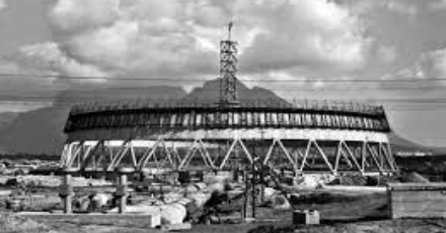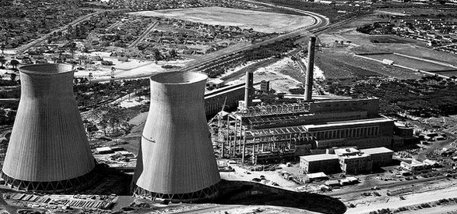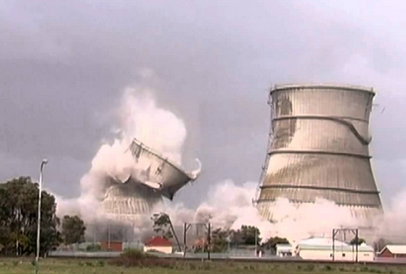
Between Pinelands and Langa stands the Athlone Power Station in the suburb of Bokmakierie. Since operation, it was the source of ongoing pollution problems, primarily in Pinelands, but also in other surrounding areas. While it was not necessarily the cause of the pollution, the two iconic cooling towers came to symbolise the problems. In February 2010, while the power station was in the process of being decommissioned, the reinforcing bands around one cooling tower collapsed leaving it structurally unsound. Plans were put in place to demolish both structures. Due to the symbolic nature of the towers, their demolition was welcomed by the surrounding communities.
The implosion was due to take place at 12 noon on 22 August 2010. To the dismay of many who were still setting up equipment to capture the moment (including live TV broadcasts) the demolition took place at 11:56:23. The reason given to the media for the early demolition was due to a sudden change in the weather and in the interests of public safety. This unfortunately was a spin to save face as the company carrying out the demolition had simply started the countdown too early. The Ward Councillor was on the podium at the time and attempted to give a warning that the countdown had started too early but the loudspeaker used for the countdown and the general surrounding noise drowned him out.
Pinelands’ involvement with the power station dates back to 1954 when the Pinelands Municipality became aware of the planned development. The Municipality wrote to the City of Cape Town to register its opposition to the siting of the proposed power station on its boundary . On-going discussions led to the Mayor of Pinelands signing an agreement with the City containing a number of conditions. Among these conditions were the creation of a green belt with 3000 trees, a security fence and the installation of highly efficient grit and dust extraction equipment.
The power station came into operation in 1962. The following year the city installed an additional dust extracting plant, turbine alternator and boiler. A further development in 1973 was the installation of a 40 megawatt gas turbine that was to be used during peak hours. By this time the low-grade coal usage had increased by 400%. Within two years the power station was operating at 220 000Klw.
In 1983, the City acted on complaints from residents about the dust emissions and found that the power station dust emission level was 25% above the legal limit. As a result, consultants were brought in to resolve the problem. Nevertheless, the problems continued, leading to a debate in Parliament by the member of parliament for Pinelands, Alex Boraine.
Due to the on-going pressure from the Pinelands Ratepayers and Residents Association, the Health Department and Ward Councillor , the power station was put on standby mode in 1984 and was non-operational for ten years. In 1994 the City explored ways to protect electricity users from tariff increases and as a result recommissioned the power station to a partial operating mode.
It was then possible to compare air pollution levels before and after the recommissioning. The comparison of the scientific data before and after showed an alarming 400% increase in sulphuric dioxide, while the soiling index increased by 84%.
Residents complained about the unacceptable noise levels in the early hours of the morning when boiler safety valves were tested. This was in breach of the undertaking signed by the City to carry out this requirement during the day . When checked, the noise level was found to be 54dBA which was 4dBA above the nationally accepted level of 50dBA
When recommissioning took place, the City undertook to install boiler exhaust gas ducting and further dust bags, establish a pollution monitoring system and to carry out modelling. Three years later, none of these undertakings had been completed. The ward councillor formed a working group which included Langa and Athlone residents with the Legal Resources Centre to deal with issues pertaining to the power station.
In 1997 the National Electricity Regulator stopped the City from carrying out any capital works as they maintained electricity could be purchased from Eskom. The Regulator found that the annual operating cost was R20m with a saving to the City of only R6m.
This led to the start of the Kudu Gas Project in the following year. City and Shell commissioned a study to explore converting the power station to gas supplied by Namibian Kudu Gas Fields which Shell and Total had discovered in 1974. Interestingly, the study found that an area in Kensington was also suitable for the project. Shell withdrew from the project in 2002 which collapsed the project and nothing further was heard of the Kudu Gas Project.
The City had also employed consultants to find ways to reduce costs to stop the National Electricity Regulator from closing down the power station. A further reason put forward to prolong the life of the power station was to enable the City to use it as a bargaining chip with Eskom. Nevertheless, the City resolved in 2006 to decommission the power station and tenders were put out for the decommissioning. The awarding of the tender ran into problems when the award was eventually overturned by the courts in 2017 causing delays in the decommissioning process.
Around this time the Pinelands ward councillor exposed the health issues being experienced by officials who had worked at the power station over the years and who had been exposed to asbestos. However, that is another story to be written.
In the interim a pre-feasibility study of the future use of the area was funded by the National Treasury in 2008 to be completed in 2010. Extensive public participation took place in the period 2009 to 2011. With the pre-feasibility study complete, the City appointed consultants to undertake detailed planning of the site and deal with all the statutory requirements for the redevelopment. This involved further public participation which took place in 2015 and 2016 for a multi-use development including housing, industry and an African cultural centre in the main building. Nothing further was heard.
The increased awareness of climate change as well as the change in the national electricity supply landscape has triggered the City to start working on a new proposal to produce renewable energy on the site. The details of what is proposed is still to be revealed.